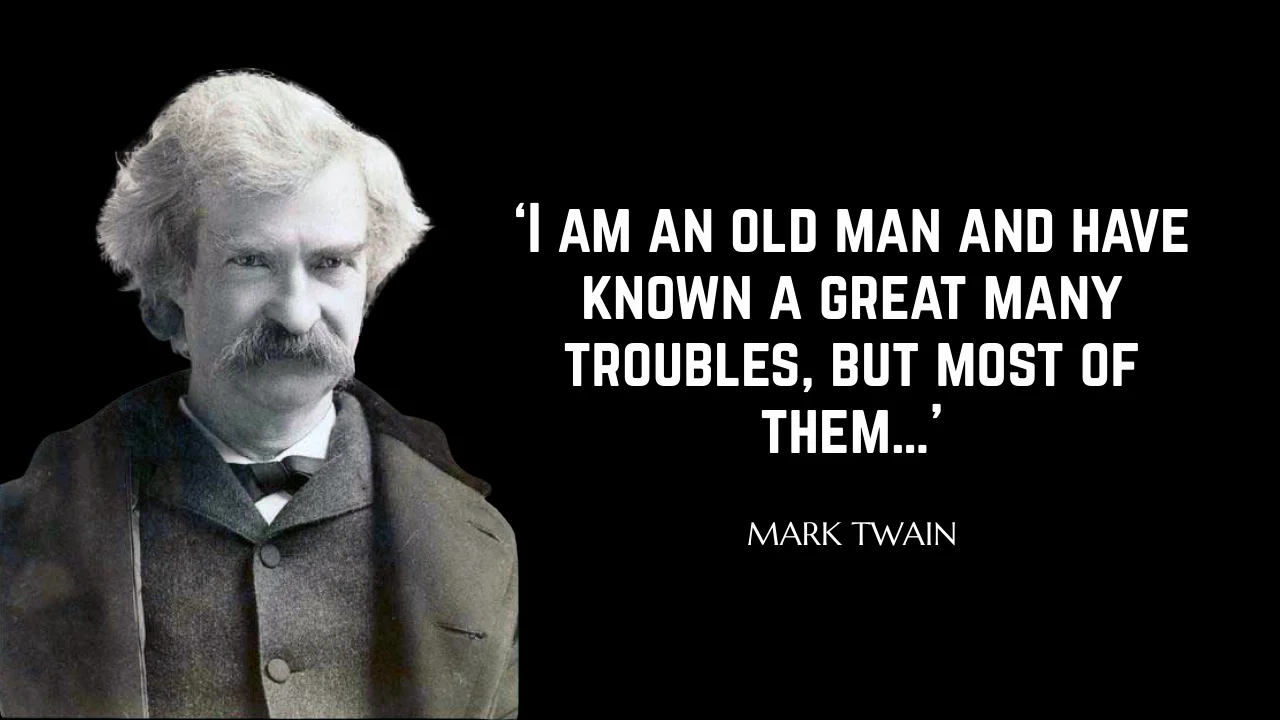
Quote of the Day by Mark Twain: Quote of the Day by Mark Twain has a way of stopping you in your tracks. It makes you think, makes you smile, and maybe even helps you breathe a little easier. The quote, “I am an old man and have known a great many troubles, but most of them never happened,” is one of those timeless reminders to not let worry run our lives. What hits hardest is how true it feels. Worry eats up so much of our energy, yet most of the time, the things we fear never come to pass.
That is why Quote of the Day by Mark Twain is more than just a witty line from a famous author. It is a reflection of human nature, the anxiety we all carry, and the humor that helps us cope with it. In this article, we are diving into the backstory of this quote, the life of the man who said it, and why these words still matter in today’s fast-paced, worry-filled world.
Quote of the Day by Mark Twain: Meaning Behind the Words
This quote may sound lighthearted, but it speaks volumes about how we process fear and stress. Mark Twain had a gift for wrapping heavy truths in simple, punchy lines. This one touches directly on how our minds tend to create problems long before they ever arrive. In fact, most never do. The phrase feels especially relevant now, when stress and mental health are such common concerns.
The Quote of the Day by Mark Twain works as a self-check. It reminds us to step back and ask: “Am I worrying about something real, or just a story I made up in my head?” That is the brilliance of Twain. He could take the human experience and, with just a few words, make it feel less overwhelming and more relatable.

Overview Table
| Key Point | Details |
| Full Name | Samuel Langhorne Clemens |
| Famous Pen Name | Mark Twain |
| Birth | November 30, 1835, in Florida, Missouri |
| Notable Quote | “I am an old man and have known a great many troubles, but most of them never happened.” |
| Writing Style | Witty, satirical, deeply reflective |
| Comet Connection | Born and died during Halley’s Comet appearances |
| Civil War Experience | Briefly served in Missouri militia before leaving |
| Career Start | Began as a printer, later became a steamboat pilot and journalist |
| First Successful Story | “The Celebrated Jumping Frog of Calaveras County” in 1865 |
| Legacy | One of America’s most quoted and beloved writers |
Mark Twain’s “Troubles” Quote Says More About Anxiety Than Humor
When Twain wrote or spoke those words, it was not just to make people laugh. He understood how much space worry takes up in our minds. This quote is about more than aging or fear. It is about the way humans tend to live in their heads, imagining problems that do not exist. Twain’s wit always carried a message, and in this case, the message is about emotional freedom.
The Quote of the Day by Mark Twain delivers wisdom in its simplest form. At its core, it is about perspective. While life does bring real challenges, Twain points out that many of the “troubles” we suffer are never real. We invent them through stress, fear, and imagination. That perspective is something we can apply to modern life, whether we are worried about our jobs, relationships, or the future.
His Birth: Cometary Cosmic Clemens?
Samuel Langhorne Clemens, known to the world as Mark Twain, was born in 1835 during a rare cosmic event. Halley’s Comet had just made its closest approach to Earth, and Twain believed there was a special connection between his life and that comet. He even said that he expected to leave this world the next time it returned. Oddly enough, he did exactly that in 1910, just as the comet passed by again.
This poetic timing only added to the mythology around him. Twain was not just a writer. He was a man who understood how storytelling shapes legacy. His life, like his words, seemed to follow its own narrative arc.

Presbyterian Parentage
Twain’s relationship with religion was complicated. He was raised Presbyterian and maintained some connection to it throughout his life. Yet, in his later years, he became a vocal critic of organized religion and questioned many traditional beliefs. Despite these views, his funeral was held in a Presbyterian church.
The influence of his upbringing still lingered in his writing. He often used religious themes and references, not to promote faith, but to challenge the rigid thinking that he believed limited people’s freedom to think for themselves.
“Rollin’ On A River…”
Growing up in Hannibal, Missouri, Twain was always fascinated by riverboats. That childhood love turned into a career when he trained to become a steamboat pilot. It took two years of study, but he finally earned his license and spent years traveling the Mississippi River.
It was from this experience that he got his pen name. “Mark Twain” was a term used on the river to measure depth, signaling safe waters. That idea of “safe passage” seems fitting for a man whose words have helped guide generations through life’s troubles.

A Brief and Inauspicious Military Career
Twain’s time in the Civil War was short and, by his own admission, not very heroic. He joined a small Missouri militia group, the Marion Rangers, but left after just two weeks. He later wrote about the experience with humor, saying he learned more about retreating than fighting.
That quick exit led him west to Nevada, where his writing career truly began. His journey from reluctant soldier to literary legend is a reminder that sometimes, quitting is not failure. It is redirection.
A Writing Career Is Born
Twain’s big break came with the story “The Celebrated Jumping Frog of Calaveras County.” Published in 1865, it became an instant hit and launched his career. From there, he went on to write classics like The Adventures of Tom Sawyer and Adventures of Huckleberry Finn.
His ability to blend humor, honesty, and deep social commentary made him stand out. Twain wrote not just to entertain, but to challenge people to think, laugh, and grow.

FAQs
What does the Quote of the Day by Mark Twain mean?
It highlights how people often create imaginary problems in their minds. Twain is encouraging us not to be consumed by worry over things that might never happen.
Did Mark Twain really say this quote?
The quote is widely attributed to him. While there is some debate, it matches his tone and philosophy, so it remains connected to his legacy.
How did Mark Twain get his pen name?
“Mark Twain” is a river term that means safe depth (12 feet). He chose it from his days as a steamboat pilot.
Was Twain religious?
He was raised in a Presbyterian family but often criticized organized religion later in life. Still, religious themes appear in much of his writing.
Why is this quote still relevant today?
Because worry is still a common part of life. Twain’s quote reminds us not to let fear control us, something that is just as important now as it was then.