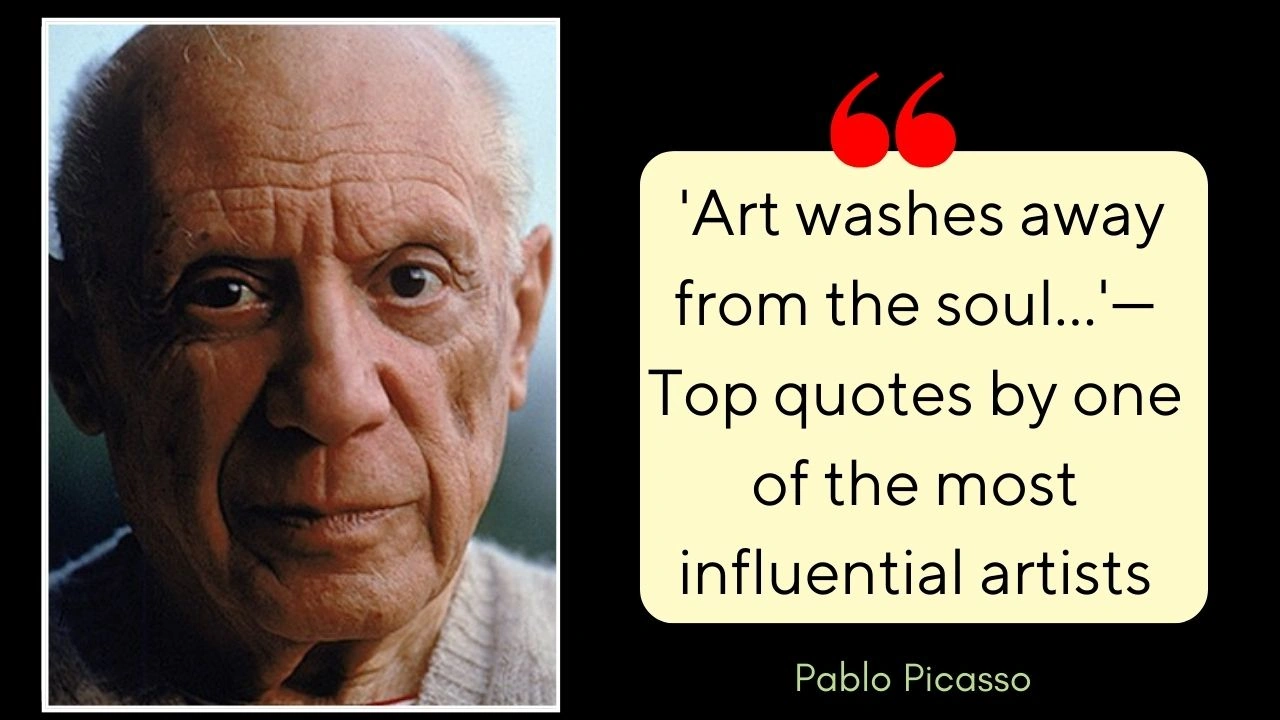
Quote of the Day by Pablo Picasso speaks to the soul in a way that few words can. His iconic line, “Art washes away from the soul the dust of everyday life,” is not just poetic but deeply reflective of his view that art is vital, not optional. It offers comfort, perspective, and a reminder of what it means to feel alive. For those searching for clarity in daily chaos, this quote offers a meaningful pause.
This article explores the Quote of the Day by Pablo Picasso and dives deeper into the life, philosophy, and artistic legacy of one of the greatest creators of the modern era. From his early beginnings in Spain to his revolutionary innovations like Cubism, we will uncover how his perspective on art still resonates today. Along with his timeless quote, we will share some of his most powerful sayings that continue to inspire creatives around the world.
Quote of the Day by Pablo Picasso
The famous Quote of the Day by Pablo Picasso, “Art washes away from the soul the dust of everyday life,” reveals his belief that creativity is not just decorative but necessary. It is not just a beautiful thought but a powerful truth for anyone weighed down by routine, stress, or emotional fatigue. Picasso saw art as something that restores our inner world. He did not view it as a luxury but as a vital way to cope with life, to breathe deeply, and to feel again. His quote invites people to return to themselves through art, to clear away the emotional clutter of everyday life, and to reconnect with something real.
Overview Table
| Key Aspect | Details |
| Full Quote | “Art washes away from the soul the dust of everyday life” |
| Artist | Pablo Picasso |
| Birth | October 25, 1881, Málaga, Spain |
| Death | April 8, 1973, Mougins, France |
| Known For | Co-creator of Cubism |
| Main Mediums | Painting, sculpture, ceramics, printmaking |
| Time Active | Over 75 years |
| Famous Work | Guernica (1937) |
| Style Periods | Blue Period, Rose Period, Cubism |
| Legacy | Most influential modern artist of the 20th century |
Who Was Pablo Picasso?
Pablo Picasso was born in Málaga, Spain in 1881 and showed remarkable artistic talent from a young age. Taught by his father, a drawing professor, Picasso soon surpassed him and began exhibiting work by the time he was thirteen. His artistic growth led him from Spain to Paris, where he was exposed to a wide range of influences that helped shape his early style.
Throughout his life, Picasso constantly reinvented himself. From his melancholic Blue Period to the more cheerful Rose Period and later the groundbreaking Cubist movement, he never stopped evolving. His deep belief in the role of art in life can be felt not only in his paintings but also in his words.
Early Life and Artistic Beginnings
Picasso’s early life played a huge role in forming his creative mind. He was only ten when he began learning art formally from his father in A Coruña. By thirteen, he had already held his first exhibition. His serious dedication to art was clear from the beginning, and his father even gave up painting to support his son’s rising career.
In 1895, the family moved to Barcelona where Picasso joined the La Llotja art academy. His work quickly earned recognition across Spain. One of his early pieces, Science and Charity, earned praise and showed his skill in traditional painting, even though he would later push far beyond those boundaries.
Breaking Away From Tradition
Although Picasso initially followed traditional academic training, he soon rejected it. Enrolling at Madrid’s Royal Academy of San Fernando, he became disinterested in formal instruction. He found more inspiration in street life and museums. This experience changed him, and after recovering from an illness in 1898, he decided to break away from family expectations and the constraints of academic art.
Picasso adopted his mother’s surname, simplified to just “Picasso,” and began signing his work accordingly. This marked his transition into a free and independent artist. It also symbolized his lifelong desire to challenge artistic norms and redefine creative expression.
Paris and the Evolution of Style
Paris became a turning point for Picasso. Immersed in the energy of the modern city, he drew influence from street scenes, nightlife, and fellow artists. But a personal tragedy, the suicide of his friend Carles Casagemas, had a profound impact. It led Picasso into his Blue Period, known for its emotional depth and focus on sadness and poverty.
Following the Blue Period came the warmer and more hopeful Rose Period. These years helped Picasso explore themes of performance, love, and humanity. They also showed how deeply he tied his emotions and surroundings to his creative output.
Cubism and Radical Innovation
In 1907, Picasso unveiled Les Demoiselles d’Avignon, a work that shattered traditional views of art. With it, he launched Cubism alongside Georges Braque. This revolutionary style rejected the idea of realistic space and introduced fragmented forms seen from multiple angles.
Cubism changed modern art forever. It encouraged artists to focus on structure and perception rather than illusion. Picasso’s innovation made people question not just how art looks, but how it works. It was one of his boldest contributions to the art world.
Art, History, and Human Suffering
Picasso’s art was not limited to personal expression. He also addressed political and historical events. His painting Guernica, created in 1937, was a direct response to the bombing of a Spanish town during the civil war. With raw emotion and symbolic imagery, the work became a universal symbol of the horror of war.
Even during World War II, Picasso did not stop creating. He worked across various mediums, returning to themes from art history and exploring new styles. His deep engagement with both the past and present made him a bridge between generations of artists.

Meaning of the Quote of the Day
The Quote of the Day by Pablo Picasso highlights the role of art as a cleanser of the soul. The “dust” represents the emotional and mental clutter that builds up from daily routines and responsibilities. Art, in his view, is not an escape but a path to rediscovery.
For Picasso, engaging with art meant reconnecting with human emotion, imagination, and honesty. This quote reminds us that creativity is more than just beauty—it is survival. It is how we stay connected to what matters most within ourselves.
Other Iconic Quotes by Pablo Picasso
Here are some more famous quotes by Picasso that show his philosophy on art and life:
- “Everything you can imagine is real.”
- “Every child is an artist. The problem is how to remain an artist once he grows up.”
- “Art is the lie that enables us to realize the truth.”
- “Others have seen what is and asked why. I have seen what could be and asked why not.”
- “Learn the rules like a pro, so you can break them like an artist.”
Each of these quotes adds to the impact of the Quote of the Day by Pablo Picasso, offering insight into his thoughts on creativity and how we live.
FAQs
1. What does Picasso mean by “Art washes away from the soul the dust of everyday life”?
He means that art helps people refresh their minds and emotions, removing stress and routine from their lives.
2. Why is Pablo Picasso’s quote considered timeless?
Because it speaks to a deep human need for creativity, healing, and personal expression, which stays relevant across all generations.
3. How did Picasso’s personal life influence his art?
His emotional experiences, like the loss of his friend, deeply affected his themes and colors, especially during his Blue Period.
4. What was Picasso’s most influential style?
Cubism was his most groundbreaking style, changing how reality was shown in art by using structure and multiple perspectives.
5. Is Picasso’s view of art still relevant today?
Yes, his belief that art is essential for emotional well-being is more relevant than ever in today’s fast-paced world.