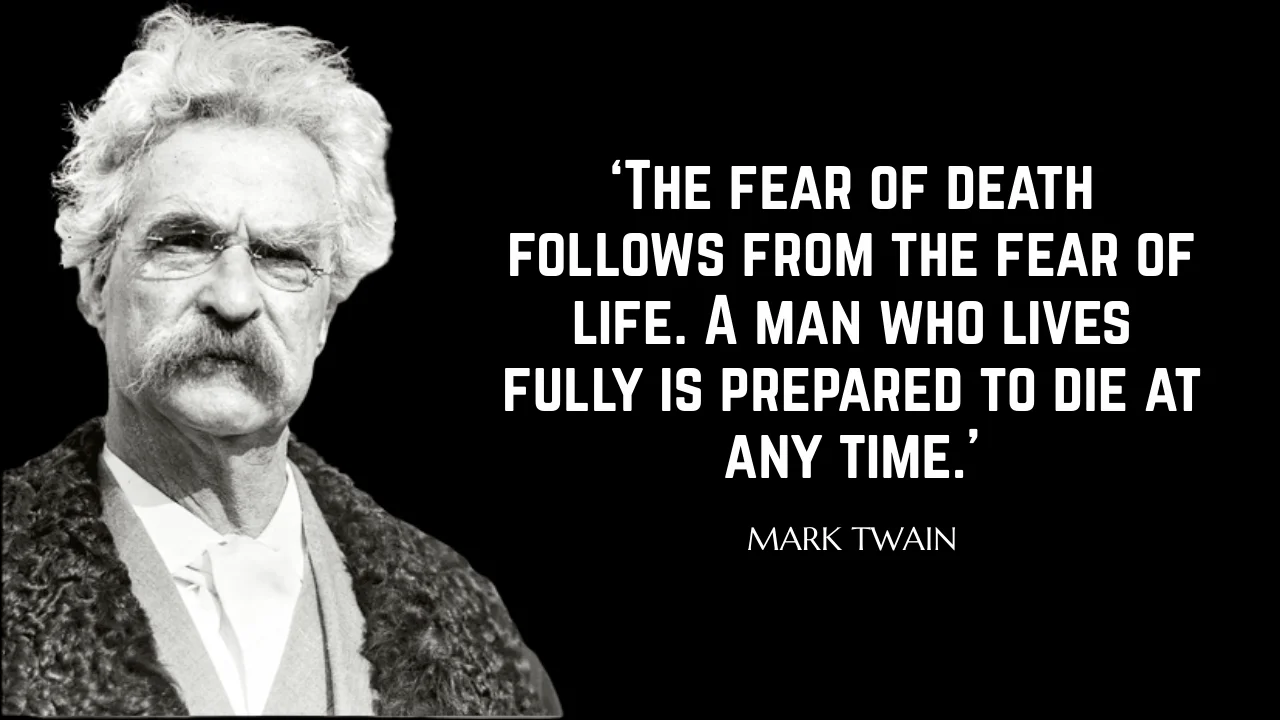
Quote of the Day By Mark Twain: Quote of the Day By Mark Twain is one of those rare lines that sticks with you long after you read it. It is the kind of quote that makes you pause, take a deep breath, and think about how you are living your life. Mark Twain had a special way of getting straight to the point, and this quote does just that. It is not just about death; it is really about life — about truly living without holding back.
This article explores the depth behind this Quote of the Day By Mark Twain. We will take a look at what shaped Twain’s worldview, the struggles and triumphs that filled his life, and how they influenced this powerful idea. If you are someone who values wisdom, adventure, or just good storytelling, this dive into Twain’s life and message is for you.
Quote of the Day By Mark Twain: What It Means and Why It Matters
Let us break it down. When Twain says, “The fear of death follows from the fear of life,” he is saying that most people fear death because they have not lived life to the fullest. If you go through life holding back, avoiding risk, or staying in your comfort zone, of course death feels like the end of something incomplete. But if you have really lived — taken chances, followed your passions, spoken your truth — then death is not something to fear. It is simply the natural end to a life well-lived.
Twain was not just talking philosophy. He lived what he preached. Through losses, failures, success, and reinvention, he kept pushing forward. That is why this Quote of the Day By Mark Twain still hits home today. In a time when many of us feel stuck, anxious, or distracted, Twain’s message is a wake-up call: live now, fully and honestly, and you will be ready for whatever comes next.

Overview Table: Glance at Mark Twain and His Quote
| Topic | Details |
| Full Name | Samuel Langhorne Clemens |
| Famous Pen Name | Mark Twain |
| Famous Quote | “The fear of death follows from the fear of life…” |
| Main Message | Live fully and fearlessly to make peace with life and death |
| Place of Birth | Florida, Missouri |
| Major Literary Works | Tom Sawyer, Huckleberry Finn, Life on the Mississippi |
| Career Roles | Printer, steamboat pilot, journalist, lecturer, author |
| Financial Challenges | Bankruptcy due to poor investments |
| Personal Losses | Death of wife and daughters |
| Legacy | Widely regarded as one of America’s greatest writers |
Early Life and Upbringing
Samuel Clemens was born into a family that struggled from the start. Raised in the river town of Hannibal, Missouri, he saw poverty, sickness, and death up close. Only three of the seven Clemens children survived into adulthood. His father passed away when Samuel was just 11, which forced him to leave school and begin working to help support his family.
His hometown, nestled along the Mississippi River, became the backdrop for many of his stories. The place, with all its charm and darkness, deeply shaped how Twain saw the world. These early experiences exposed him to the contradictions of American life, especially around race and class, and planted the seeds for the sharp social commentary that would later define his work.
The Emergence of Mark Twain
After bouncing from city to city as a journeyman printer, Samuel’s life changed when he became a steamboat pilot. The Mississippi River awakened something in him. It was during these years that he picked up the phrase “mark twain,” a river term meaning safe water depth. When he later became a writer, he used it as his pen name, linking his identity forever to the river that inspired him.
The Civil War cut short his piloting career, pushing him west. While trying to make it as a silver miner in Nevada, he instead found success in journalism. His humor, honesty, and storytelling stood out. In 1863, he signed his first piece with the name Mark Twain — and a new voice in American literature was born.

Literary Career Highlights
By the time he settled in Hartford, Connecticut, with his wife Olivia Langdon, Twain had already become a household name. His books blended satire, adventure, and moral depth in a way that had never been done before. He took simple stories and packed them with meaning. From The Adventures of Tom Sawyer to The Prince and the Pauper, his writing was both playful and powerful.
But it was The Adventures of Huckleberry Finn that became his legacy. Through Huck’s eyes, Twain tackled racism, friendship, freedom, and what it means to do the right thing. Critics and fans alike point to this book as a turning point in American literature.
Financial Failure and Redemption
Despite his success on the page, Twain was not immune to failure. He made risky investments, the worst being in an overly complicated typesetting machine that cost him everything. Bankruptcy followed, but Twain refused to walk away from his debts.
Instead, he took to the stage and went on a worldwide lecture tour. The tour was grueling, but it worked. Twain repaid every creditor in full, even though the law said he did not have to. That decision, driven by honor and grit, added another layer of depth to his legacy.

Family Tragedies
The late years of Twain’s life were filled with sorrow. His daughter Susy died of illness. His wife Olivia, who had been his partner in every way, passed away after years of declining health. Then, another daughter, Jean, died shortly before Twain’s own death. These losses darkened his writing but also deepened its meaning. He began to explore heavier topics — loss, injustice, and the cruelty of the world — without losing his sense of humor entirely.
A Man Who Lives is Prepared to Die
In the final stretch of his life, Mark Twain became more than a writer. He became a symbol of American wit, resilience, and honesty. Dressed in his iconic white suits and armed with unshakable insight, he traveled, spoke, and continued writing. He was admired across the globe.
Twain died in 1910, just after Halley’s Comet passed by Earth. He had predicted that he would go when the comet returned, and he was right. It was a poetic end for a man who lived by his own rules. His most powerful legacy, though, might be this Quote of the Day By Mark Twain, which still challenges us to live without fear and with full hearts.
FAQs
What is the meaning behind the Quote of the Day By Mark Twain?
The quote tells us that fearing death usually means we have not lived fully. If we embrace life completely, we will not be afraid of its end.

Why is Mark Twain considered a major figure in American literature?
His ability to mix humor, truth, and criticism made his work unique. Books like Huckleberry Finn helped shape American storytelling.
What inspired Mark Twain to write such deep quotes?
His life was filled with both joy and hardship. The combination of success, loss, travel, and reflection led him to express profound truths.
How did Twain handle failure in his life?
Instead of giving up after financial ruin, he paid off all his debts through a global lecture tour, showing great integrity and strength.
Why does this quote still matter today?
In a world full of stress and uncertainty, Twain’s quote reminds us that living with purpose can remove the fear of what comes next.